Located near one of the centers of rice domestication and characterized by a wide diversity of agroecosystems, Cambodia harbors a rich diversity of traditional rice landraces. However, little information is currently available on the diversity of Cambodian rice. A collection of 179 accessions representing the diversity of cultivated rice in Cambodia is conserved at the Cambodian Agricultural Research and Development Institute (CARDI), but it has so far been only limitedly characterized and exploited.
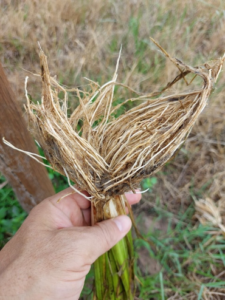
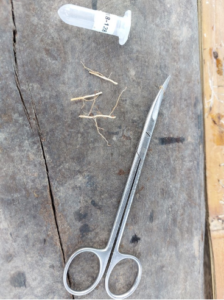
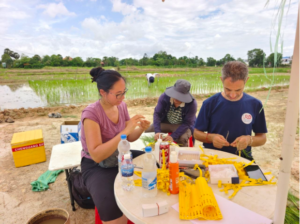
To better characterize this diversity, Laurent Laplaze coordinated the establishment of three field trials during the 2026 wet season at three contrasting sites across Cambodia using a core collection of 52 accessions. These trials have been phenotyped for root traits (L. Laplaze & S. Tan, CERES team) and will also be evaluated throughout the growing season for additional traits, including phenology, yield components, disease resistance, and other agronomic characteristics. In parallel, the entire Cambodian rice panel will be re-sequenced to generate high-quality genomic data.
This work is being carried out in close collaboration with colleagues from the Cambodian Agricultural Research and Development Institute (CARDI; Orn Chhourn), the National University of Battambang (NUBB; Pao Srean), the Royal University of Agriculture (RUA; Kimchhin Sok), the DYNADIV team at UMR DIADE (A. Barnaud, based in Cambodia since 2025), UMR PHIM (S. Bellafiore, G. Béna, and L. Moulin), and the UMR AGAP Institute (C. Grenier, CIRAD). The project has received financial support from UMR DIADE (RICE project) and the LEAD International Joint Laboratory (LMI LEAD). It will also support a PhD project for a CARDI staff member, starting in September 2026, with the aim of strengthening local expertise in genetics and genomics.