
Tropical plants play a vital role in the environment. They represent a significant part of global biodiversity, provide essential carbon sinks for the planet through forests, and support a large part of family farming.
The DIADE Joint Research Unit (University of Montpellier, CIRAD, IRD) studies tropical plants from the perspective of their diversity and functioning in order to preserve and promote them. This research contributes to the food security and sovereignty of nations and is fully in line with the agroecological transition, particularly in terms of addressing the climate challenge.
DIADE: “Diversity – Adaptation – Plant Development”
The DIADE joint research unit specializes in the study of tropical plants. It is structured into seven teams, which develop research activities, as well as training and scientific culture, in partnership with many countries in both the Global South and North.
Its work, which is based on multidisciplinary approaches and different scales, aims to produce fundamental knowledge on the diversity, adaptation, and development of tropical plants.



The study of tropical forests raises questions about the evolutionary factors that shape plant diversity.
For example, the study of tropical forests in Central Africa has revealed different evolutionary trajectories for different species in response to climate change. By combining massive sequencing, phylogeny, and population genetics, we are tracing their history and their responses to environmental disturbances.
Genetic resources, i.e., the diversity of genes within a species, are essential for adaptation. They include DNA variations and genome structure.
The DIADE unit studies this diversity to understand species evolution, their geographical distribution, and the threats they face. Through multidisciplinary approaches combining genetics and ethnoecology, it reveals the impact of social and environmental factors, such as the similar genetic richness of safou trees in rural and urban areas in Cameroon, or the adaptation of Haitian coffee trees through natural hybridization.
Our research also aims to highlight the chemical diversity of cultivated plants by studying nutritional metabolites (vitamins, fatty acids), medicinal metabolites (terpenoids), and defense metabolites (alkaloids).
By combining genomics, transcriptomics, and metabolomics, we explore their biosynthesis pathways. The Cafediv project, for example, analyzes the brown coffee tree of Réunion to understand its adaptation and promote its compounds with pharmaceutical and cosmetic potential.
A significant portion of tropical plant diversity is also useful for agriculture: this is the case for domesticated plants and their wild relatives. Understanding their evolutionary history allows us to anticipate future challenges and adapt practices.
Our research traces the origins of domestication, its impact on genetic diversity, and the trajectories of plants since their domestication. For example, we have shown that African rice was domesticated more than 3,000 years ago in the inner Niger Delta (Mali) in response to the drying up of the Sahara. This transition to agriculture, linked to the scarcity of wild resources, illustrates how environmental changes can shape societies and their practices.
We also use ancient samples (herbariums, excavations) to shed light on the history of species, such as 2,000-year-old palm seeds, opening up new avenues of research into their origins.
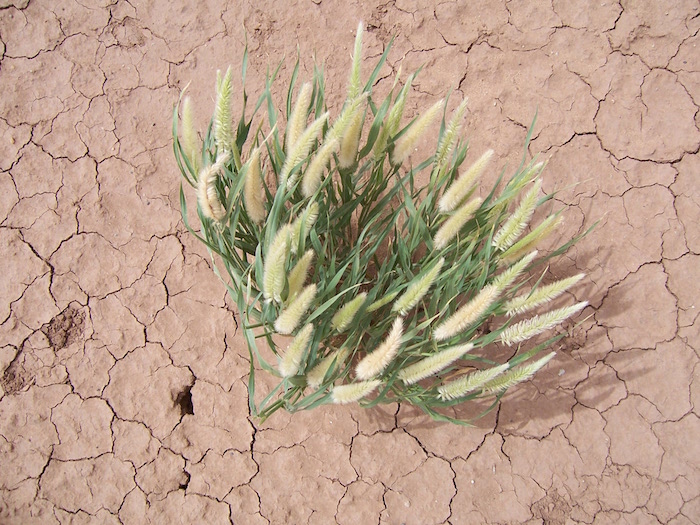
Our research contributes to a better understanding of the mechanisms controlling plant hydraulics, from water absorption by the roots to its evaporation through transpiration in the aerial parts, in dry cereals such as millet and sorghum, as well as in coffee trees.
We have set up a lysimeter platform to study the influence of controlled water regimes on transpiration and plant growth. In addition, through field trials conducted with our partners in Senegal, we have highlighted the important role of certain root traits, such as the rapid growth of the primary root of millet at depth, in tolerance to water stress.
Our studies have also enabled us to propose agronomic solutions to increase millet and sorghum yields and water use efficiency, paving the way for new varietal selection strategies.
Finally, our work focuses on the contribution of cuticular waxes to drought tolerance through the control of non-stomatal transpiration. To this end, we seek to characterize the diversity of the chemical composition of cuticular waxes at the intra- and inter-specific levels, study the relationships with water stress tolerance, and identify the molecular mechanisms involved.
We are implementing an innovative methodology known as “genomic off-set,” which uses genomics, local adaptation, and machine learning tools to project the future adaptation of crops.
Thanks to work carried out in partnership with the University of Grenoble, we are now able to include local adaptation in future climate projections and, as a result, address the consequences of future climate on crop distribution and yield.
We are studying how agrobiodiversity could help secure food production. Species that are usually neglected could prove to be important for adaptation. We are therefore helping to develop tools and conduct research on diversity to better characterize these neglected species.
Adaptation also includes the need to respond to society’s demands. One of our objectives is to make innovations accessible to farmers in the South, enabling them to reduce their use of chemicals, but also to use varieties that are better adapted to climate change and more environmentally friendly production in an agroforestry system.

Plant architecture, a determining factor in their productivity and adaptability to the environment (e.g., stress tolerance), is influenced by various branching mechanisms in root systems (coronal and lateral roots) or reproductive systems (inflorescences) and in the aerial vegetative system (axillary buds and shoots).
Our work aims to characterize the genetic regulatory networks associated with these different branching systems, in particular by studying the transcription factors of key genes in Arabidopsis and rice.
Using lateral root organogenesis and male and female germline specification as models, we seek to characterize the dynamics and function of chromatin states, the determinants of cellular identities, and the mechanisms governing the control of developmental plasticity.
Many traits influence the life cycle of plants, but those governing reproduction are particularly important for their adaptation and diversification.
In this context, we are conducting functional and comparative genomics and integrative biology approaches to study reproductive barriers between rice species, the determinism of sex separation in dioecious palms (distinct male and female individuals), the mechanisms underlying transitions between reproductive systems during the evolution of palms, the regulation of crossing-over by different (epi)genomic components, and the emergence of asexual reproduction by seeds (apomixis) in tropical grasses of the genus Paspalum.
Fruit drop causes a major loss of yield in oil palms. We have shown that fruit abscission is regulated by both developmental and environmental factors.
We are now exploiting intraspecific genetic variability to better understand the role of stress-related hormones in this process.